Consumers see reviews almost every time they search. From finding businesses nearby to planning itineraries for upcoming trips to looking up a forgotten phone number, we plug keywords into Google to help us with anything we want to know.
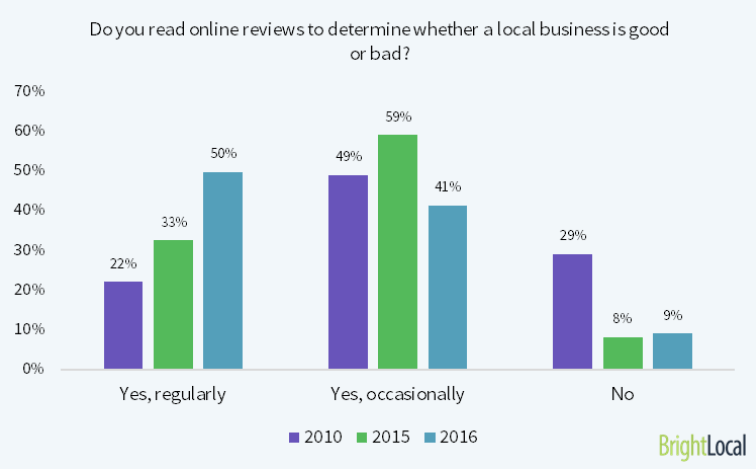
Nearly every customer checks reviews before they call, book, or buy. In BrightLocal’s 2026 Local Consumer Review Survey, 97% of consumers said they read reviews before choosing a local business, and 41% now say they “always” check reviews first, up sharply from the year before. If your Google Business Profile is thin on reviews, you’re not just missing trust. You’re missing the click before the customer ever reaches your site.
For contractors and other local service businesses, reviews aren’t a nice-to-have. They’re doing real work in two places at once: convincing the customer, and telling Google’s algorithm you’re worth ranking.
Google Reviews Build Trust Before the First Phone Call
Homeowners hiring a fence company, roofer, or landscaper are making a decision with real money and their property on the line. They’re going to look for proof before they call.
What changed in 2026 — no filter, no spin
Consumers are getting a lot pickier about who they’ll trust with their business.
Star ratings and review counts now filter people out before they even read what your customers said.
Source: BrightLocal Local Consumer Review Survey, 2026
That’s a real threshold. If you’re sitting at 8 or 12 reviews, you may be getting filtered out before a prospect even reads what people say about you. The businesses winning right now are the ones treating reviews as a moving target, not a one-time project: fresh reviews, consistently, month over month.
The SEO Benefits of Google Reviews
Google doesn’t publish its exact ranking formula, but review volume, recency, and rating are consistently tied to visibility in the Local Pack, the map and three-listing block that shows up above organic results for searches like “fence company near me.” That’s prime real estate, and it’s earned largely through your Google Business Profile, not your website.
Reviews also influence click-through rate. A profile with strong, recent reviews gets clicked more often than a competitor with a stale or empty profile, and that click activity is itself a signal Google reads as relevance. Here’s what that looks like in the wild, a real Local Pack result for a fence contractor search, where one of our clients is holding the second spot:

We hold a top-3 spot for “web design Sarasota” too.
Same mechanism at work: consistent reviews and engagement feeding the same ranking signals we’re describing here.
More clicks and better engagement translate into more visibility, which brings in more of the right kind of traffic and, eventually, more inquiries. It’s the same effect on our own end too:

Reviews Are Also Showing Up Somewhere New: AI Search
This is the part most local businesses haven’t caught up to yet. Consumers are no longer only asking Google. In the 2026 survey, the share of people using ChatGPT and similar AI tools to find local business recommendations jumped from 6% to 45% in a single year, and that shift shows no sign of slowing down.
AI tools tend to pull from the same signals: review sentiment, consistency across platforms, and how recently you’ve been reviewed. A business with strong, recent, specific reviews (mentioning your city, your service, your team by name) has a real advantage in showing up when someone asks an AI assistant to recommend a contractor nearby.
Go Beyond Google
Google is still the heavyweight, but its share of review traffic has been slipping, down from roughly 83% to 71% of consumers in the most recent survey, as more people also check Facebook, Yelp, Apple Maps, and even Nextdoor before deciding. A few reasons it’s worth spreading reviews across platforms instead of only chasing Google:
- Not every customer has, or wants to use, a Google account. Some will only leave a review somewhere else.
- Third-party reviews show up when someone searches your business name directly, giving you another chance to make a good impression.
- The average consumer now checks around six different platforms before deciding. If you’re only visible on one, you’re invisible to a lot of that research.
How to Actually Get More Reviews (Without Being Annoying)
Knowing reviews matter isn’t the hard part. Getting customers to actually leave one is. A simple, repeatable system beats a one-off “ask everyone” campaign every time:
Ask at the right moment
The best time is right after the job is done and the customer is happy, not three weeks later in a generic email blast.
Make it a one-tap process
Text or email a direct link straight to your Google review form. Every extra step you remove increases how many people follow through.
Ask the same way every time
A short, consistent script from your team removes the awkwardness and makes it a normal part of wrapping up a job, not an afterthought.
Respond to every review, good or bad
A short, human reply (not a copy-paste line) shows future customers, and Google, that someone’s actually paying attention.
Track it monthly, not sporadically
Businesses that treat review generation as an ongoing habit consistently outrank the ones that only think about it when business slows down.
If this is a process you don’t have time to run yourself, it’s exactly the kind of thing we build and manage for contractors as part of our SEO and Google Business Profile work.
Frequently Asked Questions: Google Reviews for Local Businesses
Do Google reviews actually affect my ranking, or just my reputation?
Both. Review signals feed into your Local Pack ranking, and they also drive the click-through rate that Google reads as a relevance signal. Reputation and ranking aren’t separate here; they reinforce each other.
How many Google reviews do I need to look credible?
Recent survey data shows close to half of consumers won’t consider a business with fewer than 20 reviews. That’s a reasonable baseline to aim for, with a steady stream of new ones on top.
Should I focus only on Google, or other platforms too?
Google should stay your priority, but don’t ignore Facebook, Yelp, and industry-specific directories. The average consumer checks about six platforms before deciding, so visibility in just one place leaves gaps.

Talk Strategy with Justin Harned
Ready to grow? Sit down with Rounded Digital’s co-founder to uncover what’s holding your business back online and map out a plan that actually delivers.